
Serving the U.S. and clients worldwide since 2004
Powers of attorney

Can I Sign a Foreign Power of Attorney Before a Florida Notary?
Practical guide · 6 min read · Published August 10, 2026

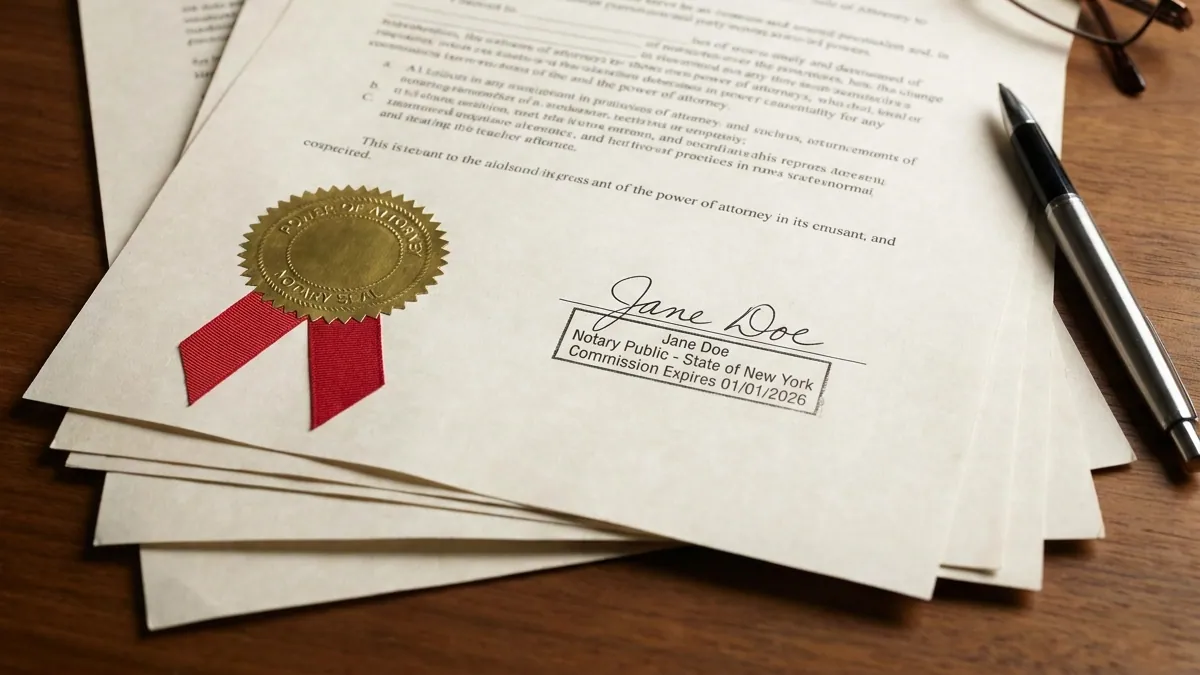
Power of attorney ready to be signed before a notary
Illustrative image; it does not represent an official document.

Many people living in or visiting Florida receive a power of attorney already drafted by a foreign attorney, notary office, or bank and need to sign it locally. The short answer is yes: a Florida notary can notarize your signature on a document intended for another country, as long as the notarial act requested (an acknowledgment or a jurat) is one a Florida notary is authorized to perform. What a Florida notary does not do is review or certify that the legal content of the power of attorney complies with the destination country's law; that responsibility belongs to the attorney or notary office that sent the document.

Quick summary

1) confirm what type of notarial act the foreign recipient requires (an acknowledgment or a jurat); 2) a Florida notary can perform that act on a document headed to another country, as long as the format is compatible; 3) the notary does not review or certify the legal content of the power of attorney; 4) after signing, the document is apostilled in Florida, because Florida is the state where the notarization took place; 5) confirm with the foreign recipient whether they accept the notarial certificate format Florida notaries use.

What a Florida notary can and cannot do

A Florida notary public is authorized to notarize signatures within the scope of their state commission, regardless of whether the document will be used in the United States or abroad. They can take the acknowledgment of your signature or administer a jurat, depending on what the document's notarial certificate requires. What a Florida notary does not do is verify that the authority granted in the power of attorney is legally sufficient for the process in the destination country, or adapt the document's wording to foreign law; that responsibility belongs to the attorney, notary office, or bank that drafted the power of attorney.

The notarial certificate has to match what the recipient requires

Many powers of attorney drafted for use in other countries include, at the end of the document, a notarial certificate block in a specific format the receiving country expects to see. Before signing, confirm whether that certificate is already included in the text or whether the Florida notary needs to attach their own standard certificate, and whether the recipient accepts the certificate format Florida notaries use. If the document does not include a notarial certificate and the notary has to use Florida's standard form, let the receiving party know before signing to confirm that format will be accepted.

Witnesses and other additional requirements

Some countries or receiving entities require, in addition to the notary's signature, one or more witnesses present at the time of signing. Florida does not require additional witnesses for most standard notarial acts, but if the document or the foreign recipient requires them, you need to arrange them yourself before the appointment; the notary is not obligated to provide witnesses and often cannot. Confirm this point with the foreign recipient before scheduling the signing.

After signing: the apostille is processed in Florida

Once signed before the Florida notary, the power of attorney is apostilled through Florida's authority, because Florida is the state where the notarization took place, regardless of the document's destination country or where the signer lives. This applies even if you are a resident of another state or country and only signed while passing through Florida. The apostille certifies the notary's signature and official capacity; it does not certify that the content of the power of attorney complies with the receiving country's law.

When signing in Florida makes sense, and when another route is better

Signing before a Florida notary tends to be the most practical option when you are already in the state, when the foreign recipient accepts standard U.S. notarial certificates, and when no specific consular appearance is required. On the other hand, if the destination country requires the power of attorney to be signed directly before its own consulate, as happens with certain Colombian processes explained in our guide on a U.S. power of attorney for Colombia, or if you prefer to avoid traveling, you may want to consider Remote Online Notarization (RON) in the states where it is available, as long as the recipient accepts it.

Common mistakes when signing a foreign power of attorney in Florida

  • Signing without first confirming with the recipient which notarial act is required (acknowledgment or jurat).
  • Assuming the notary will check whether the authority granted is sufficient for the foreign process.
  • Not bringing the witnesses the recipient requires, if the document calls for them.
  • Signing without confirming whether the recipient accepts Florida's standard notarial certificate format.
  • Not checking whether the destination country instead requires a direct appearance before its own consulate.
FAQ

Frequently asked questions

Have more questions? Send us your specific case and we'll walk through it with you.

Can a Florida notary sign a power of attorney drafted for another country?+
Yes, as long as the notarial act the document requires (acknowledgment or jurat) is one the notary is authorized to perform. The notary does not certify that the legal content of the power of attorney complies with the destination country's law.
Does the notary check whether the authority granted is sufficient?+
No. The notary authenticates the signer's identity and performs the applicable notarial act; they do not evaluate whether the wording of the power of attorney is legally sufficient for the process abroad. That is determined by the attorney or notary office in the receiving country.
Do I need witnesses in addition to the notary?+
It depends on the country or receiving entity. Florida does not require additional witnesses for most standard notarial acts; if the foreign recipient requires them, you need to arrange them yourself before the appointment.
In which state does the power of attorney get apostilled if I signed it in Florida?+
In Florida, because that is the state where the notarization took place, regardless of where you live or the document's destination country.
Can I sign through Remote Online Notarization (RON) instead of going in person?+
In states that offer RON, it is an option, but whether the foreign recipient accepts a remotely notarized document depends on that country's or entity's own rules, not on Florida. Confirm this before choosing that route.
What if the destination country requires an appearance before its own consulate?+
Then signing before a Florida notary may not be the right route; some countries require the power of attorney to be signed or acknowledged directly before their consulate. Confirm this requirement with the recipient before scheduling a notarial appointment.
Contact

Need to sign and apostille a power of attorney in Florida?

Send us the power of attorney you received, the destination country, and the receiving authority. We'll confirm the correct notarial act before you schedule the signing.

Request your power of attorney review

The notary's state, not necessarily where you live.
Add more details (optional)+
Call us

Please do not include Social Security numbers, financial account information or other highly sensitive personal data.

WhatsAppCallEmail