
Serving the U.S. and clients worldwide since 2004
Powers of attorney

My Foreign Lawyer Sent Me a Power of Attorney: What Should I Check Before Signing It in Florida?
Practical guide · 7 min read · Published August 10, 2026

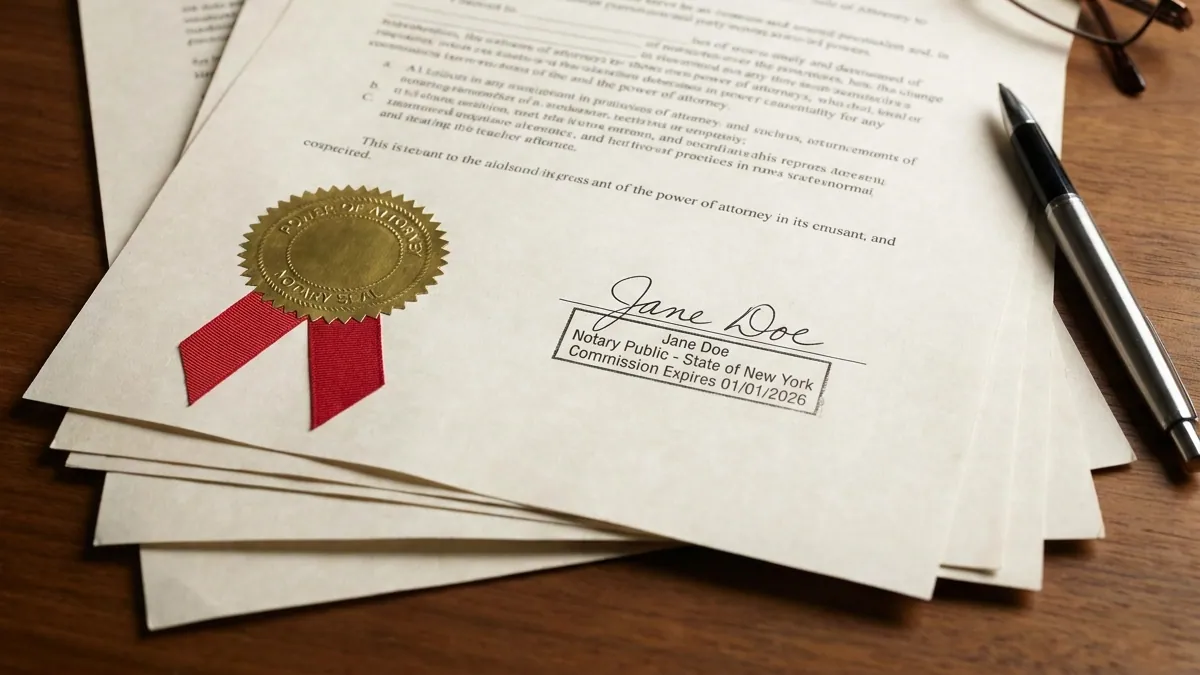
Power of attorney received by email, ready for review
Illustrative image; it does not represent an official document.

If a foreign attorney, notary office, or bank sent you a power of attorney already drafted for you to sign in Florida, the most important thing to do before signing is not to re-read the legal authority it grants — that is the responsibility of the attorney who drafted it and of you as the grantor — but to confirm the document logistics: that it will reach the right place, in the right format, notarized the way that place accepts, and with the translation and apostille it requires. This guide is a logistics checklist, not a review of the power of attorney's legal content.

Quick summary

Quick checklist before signing: 1) confirm the exact receiving authority (notary office, registry, bank, court) and the specific process; 2) confirm the format or notarial certificate the recipient expects; 3) confirm the accepted notarization method (in person or RON); 4) confirm whether an apostille or consular legalization applies, depending on the country; 5) confirm translation requirements and order (before or after the apostille); 6) confirm the identification details the power of attorney needs. Reviewing the legal authority the power of attorney grants is your attorney's and your own responsibility, not Integramerica's.

What we review, and what we don't

Integramerica can help you confirm the notarization, apostille, and translation route for the power of attorney you were sent. What we do not do, and what you should not delegate to anyone outside your attorney in the destination country, is review the legal content: what authority the power of attorney grants, whether it is sufficient for the process, or whether the scope is really what you want to authorize. That legal evaluation should be made by the attorney who drafted the document or by an attorney you trust in the destination country, before you sign.

Confirm the exact receiving authority

Before signing, confirm precisely who will receive the document: a specific notary office, a property registry, a bank, a court, or a government authority. The same type of process (a property sale, for example) can have different requirements depending on the exact institution receiving it, even within the same country. Ask the attorney or sender to confirm the receiving entity's full name and the process reference number, if one exists.

Confirm the required format and notarial certificate

Check whether the document already includes, at the end, a notarial certificate block in the format the recipient expects, or whether the Florida notary will need to attach their own standard certificate. If it isn't clear, ask the sender whether the standard certificate a Florida notary uses will be accepted, before scheduling the signing. Confirming this in advance avoids having to repeat the signing over an incompatible certificate format.

Confirm the accepted notarization method

Ask whether the recipient accepts signing through Remote Online Notarization (RON), available in Florida and other states, or requires an in-person signature before a notary. This acceptance depends on the recipient, not on Florida; you can read more about this decision in our guides on signing a foreign power of attorney before a Florida notary and on Remote Online Notarization (RON) for powers of attorney used abroad.

Confirm whether an apostille or consular legalization applies

If the destination country is a party to the Hague Apostille Convention for this type of document, the notarized power of attorney normally follows the apostille route through the authority of the state where it was signed. If the country is not a party, the document may instead follow a notarial certification and consular legalization route with additional steps. Confirm with the sender which route applies before signing, so you don't discover afterward that you paid for an apostille the destination country does not accept.

Confirm translation requirements and identification details

Ask whether the document needs to be translated before or after the apostille, who is authorized to translate according to the recipient's criteria, and whether the apostille itself also needs translation. Also check what identification details the wording requires — full legal names, passport or ID numbers, addresses — and confirm they match exactly what appears on your identity documents, to avoid a minor discrepancy delaying the process.

Final checklist before signing

  1. Exact receiving authority and specific process confirmed with the sender.
  2. Required format or notarial certificate, confirmed.
  3. Accepted notarization method (in person or RON), confirmed.
  4. Apostille or consular legalization route, confirmed based on the country.
  5. Translation requirements and order of the process, confirmed.
  6. Identification details in the power of attorney, verified against your documents.
  7. Legal authority granted, reviewed and approved by your attorney in the destination country.
FAQ

Frequently asked questions

Have more questions? Send us your specific case and we'll walk through it with you.

Does Integramerica review the legal authority the power of attorney grants?+
No. That review belongs to the attorney who drafted the document or to an attorney you trust in the destination country. Integramerica coordinates the document's notarization, apostille, and translation.
What should I confirm before signing a power of attorney sent by a foreign attorney?+
The exact receiving authority, the required format or notarial certificate, the accepted notarization method, whether an apostille or consular legalization applies, and the translation requirements.
Can I sign through Remote Online Notarization (RON) if a foreign attorney sent me the power of attorney?+
It depends on whether the recipient accepts a remotely notarized document. Confirm this with the sender before choosing that option over an in-person signature.
Where does the power of attorney get apostilled if I sign it in Florida?+
In Florida, because that is the state where the notarization takes place, regardless of the document's destination country or where you live.
Should I translate the power of attorney before sending it?+
It depends on the recipient. Confirm whether they require translation, who is allowed to translate according to their criteria, and whether the correct order is apostilling first and translating afterward, or the reverse.
What happens if the identification details on the power of attorney don't match my passport?+
A discrepancy in the name, identification number, or other detail can lead the recipient to reject the document. Verify these details carefully before signing.
Contact

Were you sent a power of attorney to sign in Florida?

Send us the power of attorney you were sent, the destination country, and the receiving authority. We review the notarization, apostille, and translation logistics before you sign.

Request your power of attorney review

The notary's state, not necessarily where you live.
Add more details (optional)+
Call us

Please do not include Social Security numbers, financial account information or other highly sensitive personal data.

WhatsAppCallEmail