
Serving the U.S. and clients worldwide since 2004
Powers of attorney

Power of Attorney for Buying or Selling Property in Colombia: Apostille Checklist
Practical guide · 8 min read · Published August 10, 2026

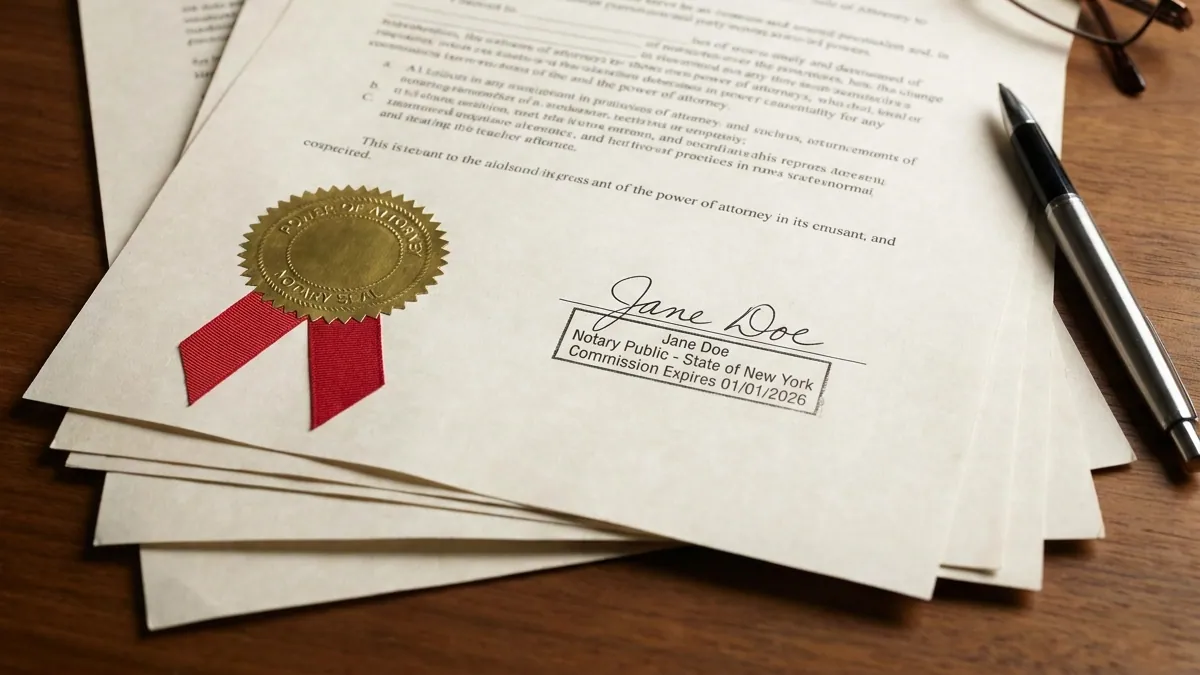
Power of attorney next to property documents
Illustrative image; it does not represent an official document.

Buying or selling property in Colombia from the United States almost always involves a power of attorney authorizing an agent to sign the deed on your behalf before a Colombian notary office. Before signing anything, the Colombian notary office, bank, or attorney has to confirm the exact wording, the express authority, and the property description that Colombian law requires for that specific transaction. This guide is a general checklist for the U.S. side of the process — notarization, apostille, and translation — not a description of Colombian legal requirements, which only the receiving notary office or registry can confirm for your case.

Quick summary

1) confirm with the Colombian notary office the exact wording and express authority required for the act (purchase, sale, mortgage); 2) confirm the property's matrícula inmobiliaria number and the exact description that must appear in the power of attorney; 3) sign the document before a U.S. notary, in person or by RON if the destination accepts it; 4) apostille the document in the state where it was notarized; 5) confirm whether the notary office requires the document in Spanish or accepts the English original with an official translation; 6) confirm whether the document needs to be a special power of attorney for that specific act rather than a general one.

This guide is an authentication checklist, not a Colombian-law summary

Every notary office, curaduría, bank, or public registry (registro de instrumentos públicos) in Colombia can have its own criteria for the exact wording, express authority, and supporting documents it requires for a real-estate power of attorney. This guide is limited to the U.S. side of authentication — notarization, apostille, and translation — and does not describe specific Colombian legal requirements, which only the Colombian notary office or attorney can confirm with certainty for your case. Our general guide on a U.S. power of attorney for Colombia covers the difference between a special and a general power of attorney, and the consular route as an alternative to U.S. notarization, in more detail.

What to confirm with the notary office or registry before signing

  • The exact wording (minuta) the power of attorney needs, including the express authority required for the act (sell, buy, mortgage, settle).
  • The property's matrícula inmobiliaria number and its precise description.
  • Full identification of the grantor and the agent (passport or cédula numbers, as applicable).
  • Whether the document needs to be a special power of attorney limited to that property and act, or whether a broader one is accepted.
  • Whether the document must arrive directly in Spanish or whether the English original with an official translation is accepted.
  • The document's validity period and any revocation conditions required.

U.S. notarization and apostille in the same state

The power of attorney must be signed before a notary public commissioned in a U.S. state, in person or, if the state and destination allow it, through Remote Online Notarization (RON). It is apostilled in the same state where that notarization took place, not the state where you live. If your document is signed before a Florida notary, for example, the apostille is processed in Florida. Before choosing RON, confirm directly with the receiving Colombian notary office whether it accepts a remotely notarized document; that acceptance depends on the Colombian notary office or registry, not on Florida law. You can review this decision in more detail in our guide on Remote Online Notarization (RON) for powers of attorney used abroad.

Alternative route: acknowledgment before a Colombian consulate

Instead of notarizing the power of attorney before a U.S. notary and then apostilling it, some grantors prefer to acknowledge their signature directly before a Colombian consulate in the United States, where the consular official performs notarial functions. This route usually avoids the extra U.S. apostille step, since the consulate itself acts as a Colombian authority, but each consulate can have different appointment requirements and forms. Our guide on a U.S. power of attorney for Colombia compares both routes in more detail.

Translation and sending the document to Colombia

If the power of attorney was signed in English, the Colombian notary office or registry will almost always require an official Spanish translation, and may have its own criteria for who is authorized to translate. A common practice is to apostille the document in its original language first and coordinate the translation afterward, keeping it as an attachment that accompanies, rather than replaces, the apostilled original. Confirm the exact order with the receiving notary office before translating, and keep the apostille physically attached to the document exactly as the issuing authority delivered it.

Common mistakes with property powers of attorney for Colombia

  • Signing before the Colombian notary office has confirmed the required wording and authority.
  • Omitting the matrícula inmobiliaria number or describing the property imprecisely.
  • Using a general power of attorney when the notary office requires express authority for that specific act.
  • Apostilling in a state other than the one where the signing notary is commissioned.
  • Choosing RON without first confirming the Colombian notary office accepts it.
  • Translating before confirming the translator and the order the recipient requires.
FAQ

Frequently asked questions

Have more questions? Send us your specific case and we'll walk through it with you.

Does this article explain Colombian legal requirements for the power of attorney?+
No. This guide covers the U.S. side of authentication — notarization, apostille, and translation. The exact wording, express authority, and legal requirements of the power of attorney must be confirmed directly with the Colombian notary office, bank, or attorney.
Do I need a special or a general power of attorney to buy or sell in Colombia?+
In most cases the notary office or registry requires a special power of attorney that expressly names the act and the property. Confirm the exact scope with the receiving entity before signing.
Can I sign the power of attorney through Remote Online Notarization (RON)?+
It depends on whether the state where you sign offers RON and, more importantly, whether the Colombian notary office or registry accepts a remotely notarized document. Confirm this with the recipient before choosing that option over in-person notarization.
In which state does the power of attorney get apostilled?+
In the state where it was notarized, not the state where you live or Colombia. Each U.S. state has its own apostille authority.
Does the power of attorney need to be in Spanish?+
It depends on the receiving notary office or entity. Some require the document directly in Spanish; others accept the English original accompanied by an official translation. Confirm the exact criteria before drafting the wording.
Does Integramerica draft the wording or confirm Colombian requirements?+
No. Integramerica coordinates the notarization, apostille, and translation of the document, but the legal wording and the authority the power of attorney should grant are defined by the Colombian notary office, bank, or attorney.
Contact

Preparing a power of attorney for property in Colombia?

Send us the draft or power of attorney, whether it's already approved by the Colombian notary office, and the state where it will be notarized. We review the notarization, apostille, and translation route before you incur unnecessary expense.

Request your power of attorney review

The notary's state, not necessarily where you live.
Add more details (optional)+
Call us

Please do not include Social Security numbers, financial account information or other highly sensitive personal data.

WhatsAppCallEmail