
Serving the U.S. and clients worldwide since 2004
International banking

Opening a Foreign Bank Account for a U.S. LLC: Which Company Documents May Need Apostilles?
Practical guide · 8 min read · August 10, 2026

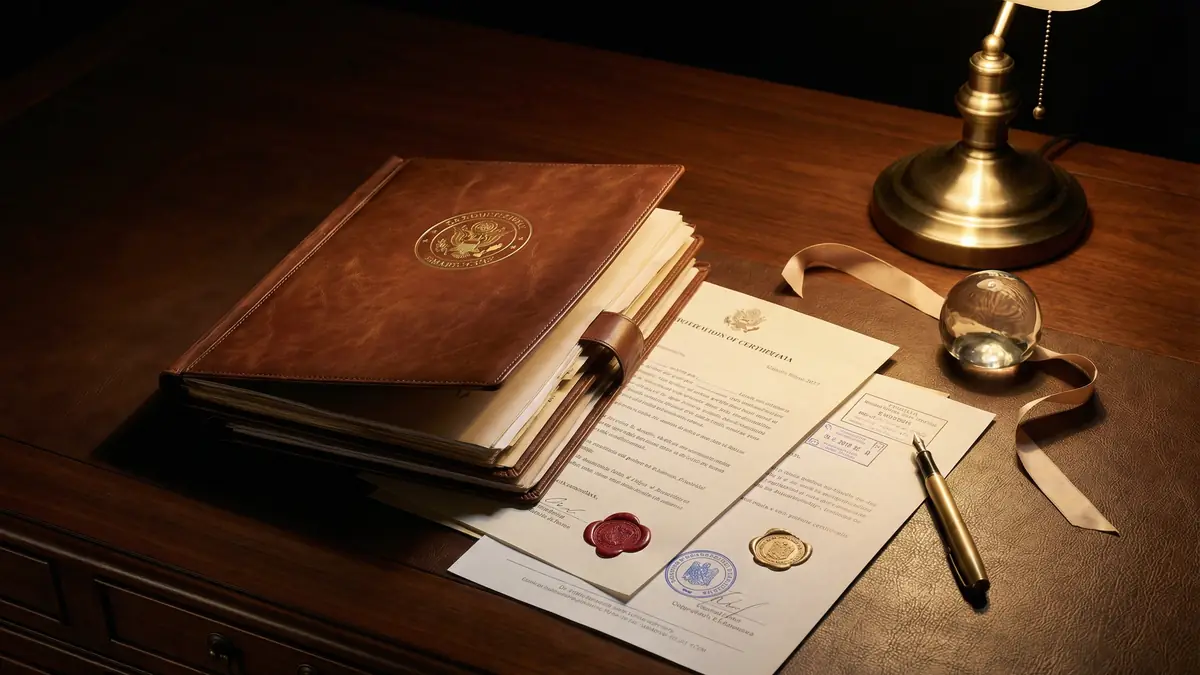
Folder with LLC corporate documents on a desk
Illustrative image; it does not represent an official document.

When the manager or member of a U.S. LLC tries to open a corporate bank account in another country, it's common for the bank to request a package of documents proving the company legally exists and that the person signing has authority to do so. Part of that package usually requires an apostille, but not every document follows the same route, and confusing one for another is one of the most common causes of delay.

Quick summary

For a U.S. LLC opening a foreign account, the document that most often needs an apostille is the Certificate of Status (or Good Standing) from the state of formation and, in some cases, a certified copy of the Articles of Organization. An internal resolution or power of attorney, if the bank requires one, is apostilled in the state where the signature was notarized, not necessarily the state of formation. The IRS EIN Letter follows different federal authentication rules. Confirm the exact list with the bank before ordering any document.

Why a foreign bank asks for authenticated corporate documents

A bank opening an account for a foreign entity, in this case a U.S.-formed LLC, needs to verify, under its own compliance and customer due diligence procedures, that the company legally exists in its home jurisdiction and that the person presenting themselves to sign has authority to act on its behalf. An apostilled document, issued by a U.S. public authority and authenticated for international use, gives the bank a verifiable way to confirm that first point. It doesn't complete the rest of the compliance process, which includes signer identification, beneficial-owner verification, and, depending on the bank and jurisdiction, other requirements of its own.

The typical file for an LLC opening a foreign account

While each bank sets its own list, the file typically requested from a U.S. LLC to open a foreign account includes, among other things: the Certificate of Status or Certificate of Good Standing from the state where the LLC was formed, a certified copy of the Articles of Organization, the EIN Letter issued by the IRS, an internal resolution or member consent authorizing the account opening and naming the signers, and identification of those signers and of the company's beneficial owners.

Which documents typically need an apostille

Of that file, the document that most frequently requires an apostille is the Certificate of Status or Certificate of Good Standing, issued by the corporate registry of the state of formation. When the bank also requests the Articles of Organization, a certified copy of that document may need its own independent apostille, processed through the same state authority that issued the certificate. If the bank also requires an internal resolution or a power of attorney, that document can be apostilled, but only if it was signed before a notary, and the apostille is processed in the state where that notarization took place, not the LLC's state of formation.

Which documents don't follow the same route

The EIN Letter (IRS Form CP 575 or an equivalent letter) is issued by a federal agency and follows its own authentication rules, separate from a state certificate. The LLC's operating agreement, when it isn't notarized, generally isn't eligible for a signature apostille, though some banks accept a certified copy through another means. Don't assume the entire file gets apostilled together or in the same place: each document has its own origin, and therefore its own authentication route.

Certificate of Status or certified Articles: not always the same thing the bank wants

It's common to confuse the Certificate of Status with a certified copy of the Articles of Organization; they are different documents that prove different things and, when both are required, need independent apostilles. If your bank asked for one of these two documents and you're not sure which, see our guide Certificate of Status vs. Certified Articles: Which One Does a Foreign Bank Need?, which explains the difference in detail before you order the wrong document.

The state that issued the document, not the state where the LLC operates

A point that often causes confusion: the Certificate of Status is apostilled through the authority of the state that formed the LLC, not the state where the company operates or has its physical address. An LLC formed in Florida but operating out of another state apostilles its certificate through Florida's Division of Corporations. An LLC formed in Delaware, even if its manager lives in Florida, apostilles its Certificate of Good Standing through Delaware's authority. If you need a step-by-step guide focused specifically on the Florida process, see How to Apostille a Florida Certificate of Status.

Apostille or consular legalization, depending on the bank's country

If the country where the receiving bank is located is a party to the Hague Apostille Convention along with the United States, international authentication is normally completed through an apostille, without additional consular legalization. If the country is not a party to the Convention, a multi-step authentication and consular-legalization chain may apply instead. Confirm the specific status of the destination country before starting any process, since not every country is treated the same way.

We don't invent the requirements of any particular bank: each institution sets its own document list and its own compliance rules. We can help you identify which of your LLC's documents are apostille-eligible and in which state they need to be processed, but the exact list should always be confirmed directly with the receiving bank.

Common mistakes when preparing the file

  • Assuming every LLC document gets apostilled in the same state.
  • Sending a photocopy of the Articles of Organization instead of a certified copy or the original.
  • Trying to apostille an operating agreement that was never notarized.
  • Requesting an apostille for the EIN Letter as though it were a state document.
  • Assuming the apostille certifies the source of funds or the company's beneficial ownership.

A practical example: a Florida LLC opening an account at a bank in Uruguay

Suppose a Florida-formed LLC wants to open a corporate account at a Uruguayan bank to receive payments from regional clients. The bank will likely ask for a current Certificate of Status, a certified copy of the Articles of Organization, the IRS EIN Letter, an internal resolution authorizing the account opening and naming the signers, passport copies for those signers, and a beneficial-owner declaration. The Certificate of Status and the certified copy of the Articles typically require a Florida apostille. The internal resolution, if notarized, is apostilled in the state where it was signed before a notary, which could be Florida or another state depending on where the signer was at the time. The EIN Letter follows a different rule that the bank needs to specify separately.

Plan with margin before the bank's deadline

Processing times for a Certificate of Status and for an apostille vary with the state office's workload at any given time, so it's best not to promise a fixed date without confirming it first. When the bank sets a deadline for completing the account opening, it's preferable to start the corporate-document process weeks ahead and verify current processing times directly with the relevant state apostille authority before committing to that date with the bank.

If your LLC is based in or near Jupiter, Florida

If your Florida-formed company is based in South Florida and needs to apostille corporate documents in person or coordinate the process locally, see our apostille service in Jupiter, Florida page to learn how we work with clients in the area.

When it makes sense to coordinate the full file with a specialized service

When the bank requires several documents with different origins, some issued by the state and others notarized in a different state, coordinating the correct sequence (for example, notarizing before apostilling, or confirming which documents require certified translation) reduces the risk of errors that force you to repeat the entire process. We can help you map which document belongs to which route before you incur unnecessary expense.

FAQ

Frequently asked questions

Have more questions? Send us your specific case and we'll walk through it with you.

Which of my LLC's documents might need an apostille to open a foreign account?+
Most often: the Certificate of Status or Certificate of Good Standing from the state of formation and, in some cases, a certified copy of the Articles of Organization. Other documents in the file, such as an internal resolution or a power of attorney, may also need an apostille, but they follow a different route because they aren't issued by the same state. Confirm the exact list with the bank before ordering anything.
Does the IRS EIN Letter need an apostille?+
The EIN Letter (Form CP 575 or an equivalent letter) is issued by a federal agency, not a state, and follows its own authentication rules, separate from a state Certificate of Status. Confirm with the bank whether it accepts the original, a certified copy, or another form of authentication before assuming a state apostille applies.
Are all of my LLC's documents apostilled in the same state?+
Not necessarily. The Certificate of Status is apostilled in the state that formed the LLC. A power of attorney or internal resolution, by contrast, is apostilled in the state where the signature was notarized, which can be a different state if the manager or signer lived or signed elsewhere.
Does a photocopy of the Articles of Organization work for an apostille?+
No. Apostilling the Articles requires the original document or a certified copy issued by the relevant state registry. A plain photocopy is not apostille-eligible.
Does the apostille certify that my LLC actually owns the funds it's depositing?+
No. The apostille authenticates the document's origin, that it was issued by the authority it claims to come from. It does not certify the source of funds, beneficial ownership of the company, or any other compliance element the bank evaluates on its own.
Do I need to apostille the LLC's operating agreement?+
It depends on whether the bank requests it and whether the document was notarized. Many operating agreements are never notarized, and a non-notarized document generally isn't eligible for a signature apostille; it may instead require a different form of certification depending on what the bank accepts.
How far ahead of the bank appointment should I start the apostille process?+
There is no fixed timeline that applies to every case, since it depends on each state office's workload at any given time. It's best to start the process weeks ahead and confirm current processing times directly with the relevant state apostille authority.
Can a foreign bank ask for different documents depending on the country?+
Yes. Each bank and each country apply their own compliance and due diligence rules. There is no universal list that applies to every bank; always confirm the exact list directly with the receiving bank.

Informational content only. Integramerica is not a law firm and does not provide legal advice. Requirements and final acceptance depend on the receiving authority. Integramerica coordinates document authentication and translation; it does not determine customs classification, product registration, FDA eligibility, origin qualification, or export licensing.

Contact

Need to apostille your LLC's documents for a foreign account?

Send us the state where the LLC was formed, the destination country, which document the bank requested, and your deadline. We'll review the route before you order any document.

Request your document review

The state that issued your corporate documents.
Add more details (optional)+
Call us

Please do not include Social Security numbers, financial account information or other highly sensitive personal data.

WhatsAppCallEmail