
Serving the U.S. and clients worldwide since 2004
International banking

Certificate of Status vs. Certified Articles: Which One Does a Foreign Bank Need?
Practical guide · 7 min read · August 10, 2026

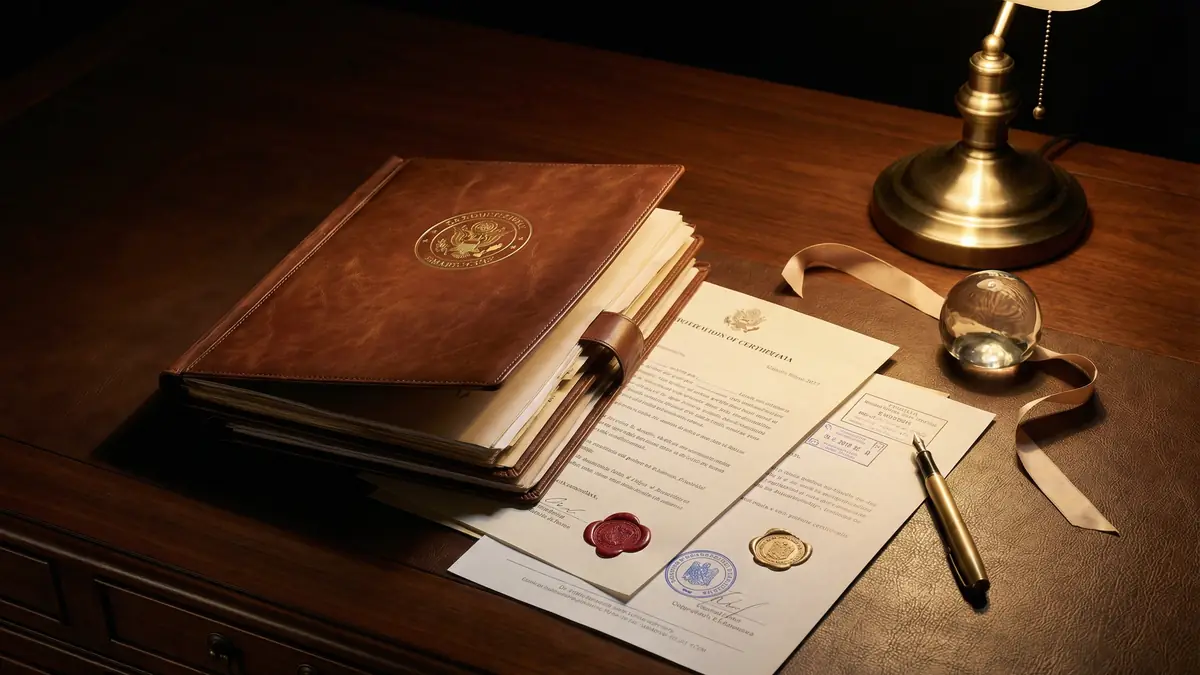
Certified corporate documents on a desk
Illustrative image; it does not represent an official document.

"We need the company document apostilled" is one of the more ambiguous requests a foreign bank can send, because in the United States there are at least two distinct documents that regularly get confused: the Certificate of Status (or Good Standing) and a certified copy of the Articles of Incorporation or Organization. Ordering the wrong one, or ordering only one when the bank actually wants both, is a common cause of avoidable delays.

Quick summary

The Certificate of Status certifies the entity is active today with the state registry. A certified copy of the Articles officially reproduces the original formation document, with the information filed at that time. They aren't interchangeable, and if the bank asks for both, you'll normally need two separate apostilles. Confirm the exact document name with the bank in writing before ordering anything.

What exactly is a Certificate of Status?

The Certificate of Status (called a Certificate of Good Standing in many other states) is a document issued by the corporate registry of the state of formation, certifying that the entity is listed as active in its records as of the issue date, and that it has paid the fees owed to that office. It's essentially a snapshot of the company's current status. It does not certify financial solvency, does not identify owners, and does not establish who has signing authority. See the full detail in our guide How to apostille a Florida Certificate of Status.

What's a certified copy of the Articles?

The Articles of Incorporation (for corporations) or Articles of Organization (for LLCs) are the document filed with the state to formally create the entity. A certified copy is an official reproduction of that document as filed, certified by the state registry. Unlike the Certificate of Status, which reflects the present, the certified copy reflects the content of the original formation document, including any later amendments that were also filed.

Key differences between the two documents

  • What they prove: the Certificate of Status proves current existence and active status; certified Articles prove the content of the formation document.
  • Relevant age: the Certificate of Status typically needs to be recent, with a maximum age set by the recipient; certified Articles reflect a fixed filing date that doesn't change, though the recipient may also require the certified copy itself to be recently issued.
  • Content: the Certificate of Status is usually brief, listing the entity's name, formation date, and registered status; certified Articles reproduce the full document, which may include the entity's purpose, its registered agent, and, depending on the state, other formation details.
  • Typical use: banks often request the Certificate of Status as proof of current standing, and certified Articles when they need to review the company's original terms of formation.

Why a bank might ask for both

A foreign bank opening a corporate account may need, at the same time, to confirm the entity exists and is currently in good standing (Certificate of Status) and to review the terms under which it was originally formed (certified Articles). As explained in Apostilled Certificate of Good Standing for a foreign bank, not every document a bank requests gets apostilled the same way, and asking for both isn't a sign of a bank error: it's common for them to answer different questions within its due diligence process.

Are they apostilled the same way?

When the company was formed in a single state, both documents are issued by the same state registry and both are apostilled through that state's apostille authority. They remain, however, two independent certifications: if the bank requests both the Certificate of Status and certified Articles, you'll normally need two separate apostilles, even if both documents are ordered the same day. Don't assume one apostille covers both just because they come from the same office.

The state of formation controls both documents

Both the Certificate of Status and certified Articles are issued by the state where the company was formed, not the state where it physically operates. An LLC formed in Delaware but with offices in Florida obtains and apostilles both documents through Delaware, regardless of where its operating headquarters sit. This differs from other corporate documents, such as resolutions or powers of attorney, whose apostille follows the state where the signature was notarized rather than the state of formation.

A practical example

Suppose a Florida-formed corporation wants to open an account at a bank in Spain. The bank asks for "proof the company legally exists" and, separately, "a certified copy of the incorporation deed." The first request corresponds to a Certificate of Status; the second, to a certified copy of the Articles of Incorporation. These are two separate processes through the same Florida office, each with its own fee and its own apostille. Ordering only one of the two, assuming it covers both requests, would mean repeating the process once the bank flags that the second document is missing.

Common mistakes

  • Ordering only the Certificate of Status when the bank actually also wanted certified Articles.
  • Submitting a printout of the public state registry record instead of either official document.
  • Assuming a single apostille covers both documents.
  • Not confirming the exact document name with the bank in writing before paying for a certification.

If you're not sure which of the two documents you need, we can help you interpret the bank's request before you pay for the wrong certificate.

If you also need a resolution or proof of ownership

The Certificate of Status and certified Articles are usually only two pieces of the file a foreign bank requests. If you've also been asked for a corporate resolution, see How to Apostille a Corporate Resolution for Use Abroad. If the bank specifically asks for proof of who owns the company, see Foreign Bank Wants Proof of Company Ownership: What U.S. Documents Can Be Apostilled?, since neither the Certificate of Status nor, in many states, certified Articles answer that question on their own.

FAQ

Frequently asked questions

Have more questions? Send us your specific case and we'll walk through it with you.

What's the basic difference between a Certificate of Status and certified Articles?+
A Certificate of Status confirms the entity is currently listed as active with the state registry as of the issue date. A certified copy of the Articles officially reproduces the company's original formation document, with the information filed at that time. They certify different things.
Can a foreign bank ask for both documents at once?+
Yes, that's common. When it happens, they're normally two independent records, and each one needs its own apostille, even if requested the same day from the same state registry.
How do I know which one the bank is actually asking for?+
Ask the bank for the exact document name in writing. Terms like "company registration," "proof of incorporation," or "company certificate" don't distinguish between the two documents, and ordering the wrong one means repeating the whole process.
Does the Certificate of Status show who owns the company?+
No. The Certificate of Status certifies the entity's current active status with the registry; it does not identify shareholders, members, or beneficial owners.
Do certified Articles show who owns the company?+
It depends on the state. Some formation forms require listing initial managers or authorized representatives; others don't require that detail. You need to check the certified copy as filed to know for your specific case.
Are both documents apostilled through the same authority?+
Yes, when the company was formed in a single state: both documents are issued by the same state registry, and both are apostilled through that state's apostille authority, though as separate certifications.
Can I use a Sunbiz printout instead of either document?+
No. A printout of the public state registry record does not substitute for either the official Certificate of Status or a certified copy of the Articles; both must be formally requested from the state's certification office.

Informational content. Integramerica is not a law firm and does not provide legal advice. Requirements and final acceptance depend on the receiving authority. Integramerica coordinates document authentication and translation; it does not determine customs classification, product registration, FDA eligibility, origin qualification, or export licensing.

Contact

Not sure which of the two documents you need?

Send us the bank's exact request (a photo or the email text works), your company's state of formation, and the destination country. We'll help identify which document to order before you pay for the wrong one.

Get help identifying your document

Add more details (optional)+
Call us

Please do not include Social Security numbers, financial account information or other highly sensitive personal data.

WhatsAppCallEmail